Tim Brand / Practical AI consulting
Practical AI,
thoughtfully
engineered.
I help small businesses make sense of AI and connect knowledge and software into useful workflows.
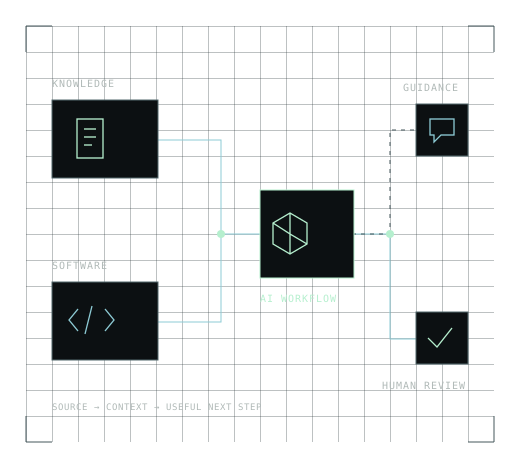
Connections, not a deployment topology.
01 / Selected work
Different problems.
Connected thinking.
From technical questions to operational evidence. A closer look at the thinking behind the workflows.

Alex
Technical knowledge, brought into the conversation. Retrieval and context support step-by-step troubleshooting.
Read the case studyProject boundaries
A capability-level description, not a deployment map or a claim of measured performance. Voice interaction is proposed, not implemented.

Alfred
Security evidence, useful reports, and a redesign shaped by sustained operational testing. Selected capture and deterministic findings support human review.
Read the case studyProject boundaries
Selected coverage, not proof of complete collection or compromise. The redesigned shift reports render findings deterministically. Identity, sustained reliability and recovery remain bounded; no automatic remediation.

GOHL Operational Overwatch
From tribal knowledge to observable operations. Independent monitoring, read-only order investigation and expert-reviewed exceptions support an existing integration platform.
Read the case studyProject boundaries
Independent observation and read-only investigation, not replacement transaction processing. No autonomous remediation, production chatbot, self-modifying rules or measured alert-precision improvement is claimed.

Adam
From an uploaded image to downloadable 3D meshes. A local generative AI application with controlled jobs, artifact checks and an exercised rollback.
Read the case studyProject boundaries
Pretrained image-to-mesh generation, not precision CAD or demonstrated physical printing. Recorded fixtures and acceptance jobs establish bounded artifact and recovery results, not speed superiority or uninterrupted operation.
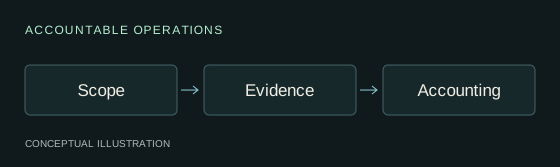
AI Operations Dashboard
A shared operational record for AI-assisted work. Project-scoped access, meaningful status history and evidence-aware time and cost accounting.
Read the case studyProject boundaries
Delivered Django application with dated release evidence. No quantified productivity or ROI claim, automatic usage ingestion, enterprise SSO or high-availability claim.
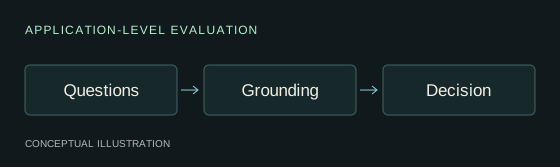
Local AI Model Evaluation
A controlled application-level comparison that led to keeping the existing backend. Source grounding, concurrency limits and tested restoration informed the decision.
Read the case studyProject boundaries
Ten fixed application questions and limited historical load runs, not a universal benchmark. Different sequence settings compare deployment recipes rather than intrinsic model performance.

Windows Infrastructure Retirement Framework
An evidence-led framework for retiring Windows components without confusing a successful shutdown with a completed transition. Scope, dependencies, recovery and real user acceptance come first.
Explore the frameworkProject boundaries
Reusable planning framework, not a completed migration case study or a substitute for a role-specific supported runbook. No client deployment or measured outcome is claimed.
Conceptual diagrams are labelled as such. Demonstration artwork, including interfaces using fictional data, is identified on the relevant project page. Each project explains its evidence and limitations.
02 / Approach
Start with the problem.
Keep the judgment.
-
01
Understand
Find the real question. Read the source material, trace the workflow and make assumptions visible.
-
02
Build
Connect the right pieces. Keep knowledge, software logic and AI responsibilities clear.
-
03
Validate
Check behavior against evidence. Explore failure cases and be explicit about what remains uncertain.
-
04
Handover
Preserve the understanding. Document the workflow, its boundaries and the decisions a person still owns.
03 / About
The work between
the pieces.
I’m Tim Brand. I help small businesses assess where AI could be useful, with a focus on connecting the knowledge and software they already use.That might mean reducing routine administration, making information easier to find or improving customer-facing workflows. I start with the practical problem and assess whether AI is a useful fit, not whether it is fashionable. Clear boundaries and human judgment matter as much as the technology.
04 / Contact
A useful conversation
starts with a real problem.
Wondering where AI might help your business? Email tim@timbrand.com with a brief description of the workflow you would like to improve. No technical brief needed; just the problem as you see it.
The link opens your email app. Please don’t send passwords or sensitive customer records.